Tuesday, 17 November 2015


The Spatial Dimension of US House Prices

Katharina Pijnenburg, DIW Berlin


House prices spill over from one region to another region. This is analysed in the literature and is known as the ripple effect. But when I plotted quarterly house price data over time for 319 US metropolitan statistical areas, I noticed that these spillovers do not seem to be uniform across space and time. When looking at this graph it is easy to see that in coastal regions rising house prices are transmitted to neighbouring regions, while this does not happen inland.

Figure 1 - Annual growth rate of regional house prices

Using non-linear estimation techniques I analyse whether house price spill overs are uniform across space and time. I find that house prices spill over more when house prices are increasing then when house prices decline.
I wondered where such a result could come from and discovered in the behavioural literature the disposition effect (Shefrin and Statman, 1985), which reflects the phenomenon in financial markets that investors sell their winning stocks too soon and hold their losing stocks too long. The disposition effect also holds for the real estate market and implies a market slowdown in times of decreasing house prices. Sellers confronting losses are likely to set higher list prices. If buyers are unwilling to pay these prices, houses stay on the market for a longer time. Homeowners could decrease list prices, but instead delay selling in order to avoid nominal losses. This behaviour reduces the transaction volume in the housing market and, consequently, limits house price spill overs.
The key question arises as to why do sellers set higher list prices and delay selling when they are confronted with a loss.
In the behavioural economics literature there are several concepts that may provide an explanation. The concept of mental accounting, for example, means that individuals group elements of their consumption and expenditures in mental accounts. They follow their personal rules in managing those accounts. When homeowners hold on to their losing asset, it is because in their mental account the loss is only booked when the asset is sold. This means that, if migration, as a driving force of house price spill overs, slows down due to loss aversion, spill overs should also decrease. Another potentially relevant concept is cognitive dissonance, the mental conflict that occurs when people find evidence that their beliefs are not true. People experiencing cognitive dissonance try to trivialize or avoid the new information, developing explanations as to why their current beliefs or assumptions should not be revised. For the housing market this would mean that homeowners avoid the information of declining house prices or try to find explanations as to why this decline does not apply to their home. Thus, they will not reduce their asking price even when confronted with falling house prices in the region. This behaviour should be reflected in smaller house price spillovers.
My analysis shows that it is not appropriate to assume that house price spill overs are uniform across space and time. In times of declining house prices spill overs are much lower than what linear estimations suggest. This result can very well be explained by taking into account seller’s behaviour. 


Wednesday, 11 November 2015

Intergenerational support shaping residential trajectories: young people leaving home in a gentrifying city

http://usj.sagepub.com/content/early/2015/11/05/0042098015613254.full.pdf+html

Cody Hochstenbach & Willem R. Boterman
University of Amsterdam, The Netherlands
 
Across many different urban contexts, young people are currently faced with increasing constraints on the housing market. Inflating housing prices and stricter mortgage lending criteria render homeownership out of reach for more and more young people who, increasingly dependent on temporary employment contracts, are unable to acquire a mortgage at all. Consequently,  increasing numbers of young people are unable to leave the parental home. Those who do manage to leave the parental home are increasingly dependent on expensive and/or temporary rental housing. Hence, the notion of an emerging “Generation Rent” has been gaining traction in the UK.
It has frequently been highlighted that parental support, in both financial and non-financial ways, may improve young people’s housing market position. Parents may help to buy a place for their offspring or cover (part of) their rental costs. Furthermore, they can provide useful social networks or broker housing in other ways – giving their offspring a head start on the housing market. Consequently, inequalities are transmitted across generations.
The impact of the intergenerational transmission of inequalities on neighbourhood outcomes is not often studied however. This is an important omission in terms of understanding inequalities in the formation of residential trajectories in relation to urban space.  
In recent years the population of Amsterdam has grown substantially, in part due to an increasing influx of students and the retention of recent graduates. These trends, combined with the housing choices of middle-class families already present in the city, have played a pivotal role in the gentrification of Amsterdam’s inner ring (a process which local authorities have been happy to accommodate and further stimulate). Simultaneously, the outer ring areas have increasingly  become sites where poverty concentrations are increasing.
In our study we  have investigated the extent to which parental support and broader class background play a role in forging young people’s neighbourhood outcomes. We particularly focused on young people leaving the parental home – a key moment in the life course and the gradual transition towards independence and adulthood.
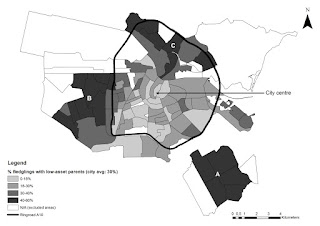
The findings are quite striking: young people with “wealthy” parents overwhelmingly move to Amsterdam’s inner-ring neighbourhoods (see the maps). These are predominantly either high-status and expensive neighbourhoods (the Canal Belt and the affluent Old South (marked with an F) being good examples), or gentrifying neighbourhoods – including neighbourhoods of already mature gentrification like De Jordaan (G), or the hip De Pijp neighbourhood (H). Young people from relatively poor backgrounds mainly move to the city’s outer ring areas (A, B, and C in the maps), often post-war extensions to the city characterized by a relatively low status. These patterns hold when controlling for a range of personal characteristics,  including income.
While the housing outcomes of young people may be the result of financial support, they also reflect broader processes of social reproduction involving social and cultural forms of capital. Facilitating their children to move into inner-ring neighbourhoods – often in relation to participation in education – is a key strategy in this regard,– making David Harvey’s work on residential differentiation highly pertinent to understanding processes of change affecting Amsterdam neighbourhoods.
The choices being effected by the children of middle class families in the Amsterdam housing market have impacted neighbourhood gentrification, and have contributed to  processes of displacement and exclusion. Young people from middle class backgrounds – despite their typically low incomes – are not only able to outbid other young people from poorer backgrounds, but can also be considered the (potential) carriers of parental wealth into previously poor (gentrifying) areas. Intergenerational wealth transfers can allow young people to pay otherwise unaffordable rents or are part of parental investment strategies in housing in areas where returns are relatively high. In such ways can parental wealth effectively be put to use to outbid other households and household types, contributing to their exclusion or displacement and ultimately advancing the gentrification process.


Source: Hochstenbach & Boterman (2015); own adaptation of CBS/SSB data.

Thursday, 5 November 2015

Surveillance in supportive housing: Intrusion or autonomy?

Cameron Parsell

University of Queensland, Australia


In my article entitled, ‘Surveillance in supportive housing: Intrusion or autonomy?’, I examine surveillance in supportive housing.

Both our theories of human behaviour and people’s relationship with place suggest that surveillance poses an intrusive force. The experience of home relies on privacy and the absence of surveillance. Home is, or at least is idealised as, a place where we can experience the freedom to live of our own volition. As a place of privacy home is juxtaposed to the city; in the modern city surveillance is omnipresent. Home is positioned as a refuge from the fluid and monitored spaces of our cities.

Theories about home, privacy, and our expectations of being free from surveillance are intuitively appealing. Although children are supervised by parents and significant others, as adults we expect to live as we choose and without scrutiny at home. Home is a place where we can do what we want, including inviting and restricting visitors as we see fit. Indeed, violence and oppression experienced in the home violate our normative expectations that home is a place of peace and order where we can exert control.

The significance of home as a place free from surveillance, on the one hand, and new models of supportive housing that purposefully adopt surveillance mechanisms, on the other, motivated the research driving my article. I wanted to examine the function of surveillance. In the research I sought to empirically study how tenants experienced surveillance, and how housing and support providers understood the role of surveillance in the lives of those monitored.

The research identified two key findings. First, and consistent with existing theories, surveillance was controlling and restrictive. Tenants experienced, and housing and support providers advocated for, surveillance to intervene to restrict freedoms and to protect vulnerable people. It was recognised among tenants and housing and support providers alike that surveillance is counterproductive to achieving independence and self-determination.

Second, the research found that instead of simply being passively subject to surveillance, tenants purposefully used surveillance for their advantage. Surveillance in supportive housing was a resource actively used by tenants to create the conditions to control their lives. Tenants saw surveillance as playing a desirable role. Surveillance, as provided through the concierge and onsite support workers, meant that tenants could achieve safety and security by minimising the threats posed by others. Tenants used surveillance to restrict unwanted visitors. Contrary to what may be expected based on theories of home as a place of privacy, surveillance was a resource that tenants drew on to exercise control and autonomy over how they lived.

The research’s contribution is to demonstrate the desirability and utility of surveillance in supportive housing as a mechanism to achieve safety and control for tenants who had otherwise experienced violence and marginalisation in mainstream housing and as homeless. For people who had experienced unsafe neighbourhoods and forms of accommodation – for people who were unable to draw on informal resources and networks to achieve safety and control – formal surveillance constituted a useful resource. Although surveillance acted to limited autonomy, it was also used as a resource that enabled people to exercise control. Surveillance is thus not the antithesis of home.

Friday, 18 September 2015

Sol Gamsu - The re-location of elite and middle-class schools


Sol Gamsu, King's College London, discusses his article "Moving up and moving out: the re-location of elite and middle-class schools from central London to the suburbs". Download the article here: http://usj.sagepub.com/content/early/2015/08/27/0042098015601593.abstract?rss=1


Tuesday, 15 September 2015

Collective or individual titles? Conflict over tenure regularisation in a Kenyan informal settlement

Andrea Rigon - University College London, UK


The urban regeneration of poor neighbourhoods is an increasingly common intervention in cities across the world. These interventions are often accompanied by market displacement and gentrification, processes through which some local residents benefit from the increased value of their properties whilst others cannot afford to continue living in the area and are replaced by more affluent people. A key policy concern is therefore the ways in which such interventions can protect current residents from displacement and allow them to remain in their neighbourhoods. In the context of fast growing African cities – where land is rapidly appreciating and often contested – ensuring that residents of informal settlements, particularly tenants, can continue living in their settlements of origin after regeneration interventions is particularly challenging.

My research analyses a specific slum-upgrading project in an informal settlement of Nairobi in which there were different interests amongst diverse groups of residents. I explore the negotiations over tenure regularisation, including in particular the proposed use of a collective form of land titling through the creation of a Community Land Trust, explicitly with the aim of reducing displacement and gentrification. While at first glance a very attractive option, I argue that such tenure reforms are always shaped by context-specific power relations, and that in this particular case the process came to be dominated by the implementers’ need to maintain fragile agreements with local elites in order to avoid conflict. Elite pressure led to a change in project’s objectives, which makes it more difficult for tenants to afford living in the settlement in the long-term. Ultimately, then, what my case shows is that tenure reforms are based on different ideas of whose rights should be recognised and competing claims that are both negotiated through and shaped by the implementation process.


This research contributes to policy-oriented and theoretical debates on how to approach the complex task of upgrading informal settlements, which now host a quarter of the world’s urban population and over 60% of Africa’s urban population, according to UN-Habitat. While policy innovation, in terms of new tenure approaches is sorely needed, any project should be aware that technical solutions are likely to fail if they do not take into consideration power relations and how these shape implementation through the daily encounters between different groups of residents and project implementers. In particular, urban land reform outcomes are likely to be shaped by local power relations and the relative power of state and non-state actors involved in the process of detailed planning and implementation rather than land policy decisions taken at higher levels.

Tuesday, 8 September 2015

Transforming transport planning in the postpolitical era

Crystal Legacy (Centre for Urban Research, RMIT University, Australia)
 

This research examines the transformation of the democratic systems that support transport decision making in Australian cities. The focus of the paper is the controversial East West Link road tunnel proposed for the inner suburbs of Melbourne, Victoria. Following the state government decision to fast track the signing of the contracts for this project, concern that this would remove public debate about the efficacy of the proposed tunnel eventually proved unfounded. Instead, the closing down of debate by the government spurred debate to occur elsewhere.  My ambition in this project was to understand the intricacies of the opposition to this controversial road project, but, more specifically, to examine the ways in which different community-based groups organised to stop a project and do so in a way that offers a transformative urban transport agenda for the State. When a government deliberately closes its door to open citizen engagement, particularly around discussions of transport priorities, I was interested in investigating how community based groups and individual residents alike can move beyond NIMBY-focused and site specific agitation to garner a spatially dispersed re-politicisation of urban transport priorities? I set out to consider how a reconceptualisation could transpire, and in what ways could a political orientation of the problem provide a platform for a redemocratisation of transport planning?

When the research commenced, I was nearing the end of my semester of teaching Integrated Transport Planning. Motivated by the high level of student activism that catalysed the creation of the Students Linking Melbourne Sustainably (SLiMS) group, my research assistant Daniela Minicucci and I set out to follow and engage groups like SLiMS through an ethnographic study of the politicisation of transport in Melbourne. This included participation in community organised street protests, engagement in public forums and debates about urban transport policy at community meetings and in the media. I also followed Twitter feeds and hastage discussions as well as participated in meetings with leaders in the community campaign against the East West Link.  To develop a more robust understanding of the motivations and strategies embraced by the groups, and to help with my analysis of the variety of ways these groups were working collectively to stop the project, I also conducted 15 semi-structured interviews with the lead campaigners. Even though the substantive aspect of my research focused on a 6 month period of state-led community engagement with a highly flawed Comprehensive Impact Statement process, my interest in these groups continued unabatedly into the state election in November 2014 when, following months of political pressure from these groups in the lead up to the election, and after signing the contracts, the party in power was defeated. Through the campaign, which included savvy engagement with the political parties and major media outlets, the community-based groups were able to position the project onto the state’s political agenda in the lead up to the election. This enabled the newly elected government to remove the East West Link from the top of the transport infrastructure priority list following the election. Shortly thereafter the contracts were broken.

The paper’s contribution is to illustrate how the politics of transport evolves and is played out.  Any decision to remove the community from the processes that determine the priorities of transport investment, are inherently political decisions and therefore any attempt to depoliticise decision making, be that through streamlining decision making or by narrowing the scope for citizen participation, only serves to hyper politicise projects. A key conclusion of the paper is the need for new urban governance settings that both respond to and embrace the political aspects of transport planning and decision making.  But in the absence of inclusive governance arrangements, politically engaged citizens will go to great lengths to create their own spaces where deliberations about transport problems, priorities and investments can occur, but in a manner that allows alternative transport futures to also be considered. These informal processes offer an illustration of the redemocratisation of transport planning. To the extent that citizens can influence transport decision making (and they can!), a closed system of transport decision making does not close down debate and community action.