Wednesday, 27 January 2016

Being Visible in Public Space: The Normalization of Asymmetrical Visibility

Tali Hatuka and Eran Toch

http://usj.sagepub.com/content/early/2016/01/19/0042098015624384.full


When and where do we choose to share information about ourselves? How do we perceive public space and virtual space? How these perceptions influence our practices of ‘seeing and being seen’? These are the key questions in this paper, which aims at better defining the idea of visibility, seen as a practice that constitutes forms of noticing, managing attention, and determining the significance of events and subjects. In this paper we argue that the notion of visibility is influenced from the dynamic – of data collected vertically ‘in the name of public safety’ (i.e., top-down surveillance and ‘smart’ data centres) and data being shared horizontally ‘in the name of democracy’ (i.e., through individuals’ social networks) – which contributes to a sense of ‘being exposed’ in public space. This sense or condition normalizes practices of sharing and thus contributes to the norms of personal data exposure. It is important to note that this vertical-horizontal dynamic is not a dichotomist condition but should be seen as a set of juxtaposed methods of information collection and sharing that enhances Asymmetrical Visibility and contributes to its Normalization.


Seeking to understand the condition of visibility in public and, in particular, the manner in which visibility is activated and perceived by the self, the focus of the paper is on behavioural practices and the sharing of data in different social settings. We show that individuals are aware of the varied meanings of the idea of visibility when appearing in public and sharing personal information. Indeed, the practice of sharing information is not a new phenomenon, but the new technologies have transformed this practice for many.  


To collect the quantitative information, an Android application called Smart-Spaces was used that combines smartphone-based surveys with online tracking of locations and phone application usage. The Smart-Spaces application was installed for 20 days on the phones of students at Tel Aviv University, during which the participants answered context-based surveys during their daily routines. Each participant was interviewed before and after the instalment of Smart-Spaces. Our quantitative findings show that there is a correlation between the type of space and the willingness to provide information, with high willingness to share one’s location and other information in public spaces. In summary, the proportion of places that are considered public is closely correlated with the number of people nearby. Essentially, a ‘public’ place is a place with many people, even if it is a closed space. In association with this finding, it is not surprising to find that people are less likely to share their locations when they are with friends, and they are slightly less likely to share their locations when they are working. However, what is surprising is the broader picture. As a whole, the participants were not bothered by sharing slightly more than 73% of their locations. Thus, while there are differences between sharing preferences in different types of spaces, these differences are weaker compared to the overall willing to share all locations. Our qualitative findings show that the participants see convergence between the online and offline worlds. For most of the participants, exposure and practices of visibility are an integral and major part of daily life, both in public and virtual space.
Acknowledging that we live in a technology-based society and that individuals have more tools to manage and ‘show’ themselves in public, the question becomes how the practices of collecting data through location-based technologies change not only users’ perceptions but also public space itself. The question is not so much whether public space as experienced today and monitored is still public, but rather what are the lenses through which we need to look at it. As this study showed, the self in public space is (willingly or not) becoming an identifiable subject.


Tuesday, 22 December 2015

Women’s behavior in public spaces and the influence of privacy as a cultural value: The case of Nablus, Palestine

Shadi Ghadban, Manal Al- Bishawi, Karsten Jorgensen


In this study, we seek to study women’s need for privacy in public spaces and how this need influences both women’s behavior and the physical form of public spaces particularly in Arab-Muslim cities, where culture plays a critical role in driving women's behaviour.    Women’s privacy in this context is influenced by the culture of gender separation, which is based on local traditions dominant in Arab-Muslim cities.   Therefore, this study primarily deals with women’s privacy in the presence of outsider males, who are treated as strangers and do not have a family relationship with the women and are eligible for marriage. The city of Nablus, as being an Arab Muslim city in Palestine, is presented as a case study to provide a perspective on how the cultural needs of women in general, and women's privacy in particular, are accommodated in a local context.

Although several studies concerning public spaces and women’s privacy in Arab-Muslim cities have been conducted, most scholars of these studies do not give a clear picture of the relationship between privacy and its different components. The scholars focus on investigating privacy in relation to behaviour or in relation to physical form of the space without explaining well enough how both people’s behaviour and the physical form of the space are influenced by privacy.  In other words, scholars have tended not to explain clearly enough the relationship between privacy and its components.

To analyse the physical space in relation to women's behaviour an environmental approach based on the concept of behavioural setting was used. For this purpose, the behavioural setting was defined as the smallest living entity in a space that has three main components: physical (design), social (use) and cultural (rules).

The outcome of this study is expected to contribute to developing of a better theoretical understanding of the relationship between women’s privacy and the physical form of public spaces. In addition, it will enhance the knowledge about the interaction between urban design and culture in general, and between urban design, democracy and equity among citizens in using their urban environment, in particular.  Thus, women’s privacy in this regard does not mean women's isolation from public sphere; on the contrary it is an essential requirement for women to achieve their right in accessing the public sphere.  This will help urban planners to design and develop sustainable urban environments which are accessible to both males and females.                                                                                                             

The result of this study shows that there is a relationship between women’s privacy and both women’s behavior and physical form of the space.  The paper shows that women’s privacy is met through the design, use and rules of  space.   Therefore, on one side, it is possible to investigate and influence privacy through urban design components.  On the other side, it is important to consider all these components in the design and development of built environment.

Tuesday, 17 November 2015


The Spatial Dimension of US House Prices

Katharina Pijnenburg, DIW Berlin


House prices spill over from one region to another region. This is analysed in the literature and is known as the ripple effect. But when I plotted quarterly house price data over time for 319 US metropolitan statistical areas, I noticed that these spillovers do not seem to be uniform across space and time. When looking at this graph it is easy to see that in coastal regions rising house prices are transmitted to neighbouring regions, while this does not happen inland.

Figure 1 - Annual growth rate of regional house prices

Using non-linear estimation techniques I analyse whether house price spill overs are uniform across space and time. I find that house prices spill over more when house prices are increasing then when house prices decline.
I wondered where such a result could come from and discovered in the behavioural literature the disposition effect (Shefrin and Statman, 1985), which reflects the phenomenon in financial markets that investors sell their winning stocks too soon and hold their losing stocks too long. The disposition effect also holds for the real estate market and implies a market slowdown in times of decreasing house prices. Sellers confronting losses are likely to set higher list prices. If buyers are unwilling to pay these prices, houses stay on the market for a longer time. Homeowners could decrease list prices, but instead delay selling in order to avoid nominal losses. This behaviour reduces the transaction volume in the housing market and, consequently, limits house price spill overs.
The key question arises as to why do sellers set higher list prices and delay selling when they are confronted with a loss.
In the behavioural economics literature there are several concepts that may provide an explanation. The concept of mental accounting, for example, means that individuals group elements of their consumption and expenditures in mental accounts. They follow their personal rules in managing those accounts. When homeowners hold on to their losing asset, it is because in their mental account the loss is only booked when the asset is sold. This means that, if migration, as a driving force of house price spill overs, slows down due to loss aversion, spill overs should also decrease. Another potentially relevant concept is cognitive dissonance, the mental conflict that occurs when people find evidence that their beliefs are not true. People experiencing cognitive dissonance try to trivialize or avoid the new information, developing explanations as to why their current beliefs or assumptions should not be revised. For the housing market this would mean that homeowners avoid the information of declining house prices or try to find explanations as to why this decline does not apply to their home. Thus, they will not reduce their asking price even when confronted with falling house prices in the region. This behaviour should be reflected in smaller house price spillovers.
My analysis shows that it is not appropriate to assume that house price spill overs are uniform across space and time. In times of declining house prices spill overs are much lower than what linear estimations suggest. This result can very well be explained by taking into account seller’s behaviour. 


Wednesday, 11 November 2015

Intergenerational support shaping residential trajectories: young people leaving home in a gentrifying city

http://usj.sagepub.com/content/early/2015/11/05/0042098015613254.full.pdf+html

Cody Hochstenbach & Willem R. Boterman
University of Amsterdam, The Netherlands
 
Across many different urban contexts, young people are currently faced with increasing constraints on the housing market. Inflating housing prices and stricter mortgage lending criteria render homeownership out of reach for more and more young people who, increasingly dependent on temporary employment contracts, are unable to acquire a mortgage at all. Consequently,  increasing numbers of young people are unable to leave the parental home. Those who do manage to leave the parental home are increasingly dependent on expensive and/or temporary rental housing. Hence, the notion of an emerging “Generation Rent” has been gaining traction in the UK.
It has frequently been highlighted that parental support, in both financial and non-financial ways, may improve young people’s housing market position. Parents may help to buy a place for their offspring or cover (part of) their rental costs. Furthermore, they can provide useful social networks or broker housing in other ways – giving their offspring a head start on the housing market. Consequently, inequalities are transmitted across generations.
The impact of the intergenerational transmission of inequalities on neighbourhood outcomes is not often studied however. This is an important omission in terms of understanding inequalities in the formation of residential trajectories in relation to urban space.  
In recent years the population of Amsterdam has grown substantially, in part due to an increasing influx of students and the retention of recent graduates. These trends, combined with the housing choices of middle-class families already present in the city, have played a pivotal role in the gentrification of Amsterdam’s inner ring (a process which local authorities have been happy to accommodate and further stimulate). Simultaneously, the outer ring areas have increasingly  become sites where poverty concentrations are increasing.
In our study we  have investigated the extent to which parental support and broader class background play a role in forging young people’s neighbourhood outcomes. We particularly focused on young people leaving the parental home – a key moment in the life course and the gradual transition towards independence and adulthood.
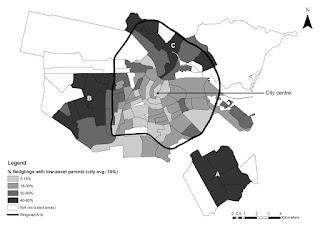
The findings are quite striking: young people with “wealthy” parents overwhelmingly move to Amsterdam’s inner-ring neighbourhoods (see the maps). These are predominantly either high-status and expensive neighbourhoods (the Canal Belt and the affluent Old South (marked with an F) being good examples), or gentrifying neighbourhoods – including neighbourhoods of already mature gentrification like De Jordaan (G), or the hip De Pijp neighbourhood (H). Young people from relatively poor backgrounds mainly move to the city’s outer ring areas (A, B, and C in the maps), often post-war extensions to the city characterized by a relatively low status. These patterns hold when controlling for a range of personal characteristics,  including income.
While the housing outcomes of young people may be the result of financial support, they also reflect broader processes of social reproduction involving social and cultural forms of capital. Facilitating their children to move into inner-ring neighbourhoods – often in relation to participation in education – is a key strategy in this regard,– making David Harvey’s work on residential differentiation highly pertinent to understanding processes of change affecting Amsterdam neighbourhoods.
The choices being effected by the children of middle class families in the Amsterdam housing market have impacted neighbourhood gentrification, and have contributed to  processes of displacement and exclusion. Young people from middle class backgrounds – despite their typically low incomes – are not only able to outbid other young people from poorer backgrounds, but can also be considered the (potential) carriers of parental wealth into previously poor (gentrifying) areas. Intergenerational wealth transfers can allow young people to pay otherwise unaffordable rents or are part of parental investment strategies in housing in areas where returns are relatively high. In such ways can parental wealth effectively be put to use to outbid other households and household types, contributing to their exclusion or displacement and ultimately advancing the gentrification process.


Source: Hochstenbach & Boterman (2015); own adaptation of CBS/SSB data.